The Den of Slack

emilymorganti.com

Page 135 of 241

A very complicated door

One of the first components I splurged on for this house was a Bespaq Newport double door for a whopping $34. Not entirely sure what my color scheme would be, I got the white one, thinking I could paint it. But then I realized the door wouldn’t easily come apart — unlike a Houseworks door, the pin hinges are hidden (no way to pull them out and remove the doors from the frame), plus the windows (which are real glass) don’t slide out. The idea of painting it gave me a conniption. So I splurged again and got the wood version… which I also wasn’t entirely happy with. It just seemed too dark and put the house off balance.

I recently checked out In the Victorian Style again from the library to get some ideas for my fireplaces, and while I was flipping through it I saw a picture of a San Francisco Victorian that had a stained door and realized what the problem was. I needed a trim that would match the windows etc., but a stained door. (I’d actually thought of this already — combining the two doors together somehow — but seeing the picture in the book confirmed it.)

Lucky for me, when I ordered my stained door it arrived in pieces. The manufacturer ultimately sent me a replacement, but this meant I had one that was already taken apart to play with. And it made me bolder about playing around, since I’d always have the whole one to fall back on if I needed to. These things are too expensive to mess around with!

I’d already damaged my white door a little by stepping on it (oops) and it had some imperfections to begin with, so I didn’t feel too bad breaking it apart. Ideally I would have just painted the white frame, slipped in the stained doors, and been done with it. But the white door and the stained door weren’t the same dimensions. The stained doors were slightly taller and wider. I’m not sure if they came from different batches or what, but it made this a more complicated project.

Here are the pieces I came up with.

The sunburst header off the white doors had a fairly thick piece of wood at the bottom of it, which made the hole too short for the stained doors to fit into. I sanded off quite a bit of this, both on the bottom side and on the top side. This had the added benefit of getting the white paint off, so I was able to stain the part that forms the top of the door frame.

After giving it a lot of thought (like, sitting and staring at the door hole for *hours*) I decided that pin hinging wouldn’t work because the top piece didn’t quite extend the width of the two doors, and the bottom is currently a gaping hole (you’ll see it in later pictures). So, I decided instead to hinge it like a real door. I don’t think these are half scale hinges but they’re what I had, and looking at my own front door for reference, they didn’t seem too large. I attached each hinge with super glue, moving the hinge while the glue dried to keep it from getting stuck, and then pushed brads into the nail holes.

Continue reading

Queen Anne Rowhouse – prettying up the hallways

Okay, they’re not hallways exactly, but the Queen Anne Rowhouse has two rooms that are dominated by stairs. If I’d built this house myself I would have left out the wall between the “stair room” and the “bay window room” on one or both floors. But it came with walls snugly in, so I decided to suck up the fact that 20% of my usable space would basically be glorified hallways.

Back in February, my dad helped me build two crazy staircases that would work in these rooms. (It was no small undertaking!). Since then I’ve been slowly finishing the rooms, but I was held up by some electricity and wallpaper logistics. In particular, I wanted the wall that the stairs go up against to have one continuous piece of paper without any trim or gaps in it, just like in a real house. My first attempt was thwarted when I underestimated how visible the wire running down from the attic would be under the paper. Dissatisfied, I ripped it out, added a piece of stiff paper upstairs to cover the wire, and tried again. This time I had trouble gluing the very inside corner because my stiff paper didn’t go all the way to the corner and this prevented me from getting a nice clean seam. In attempting to fix it, I made a huge mess and ultimately ripped out the paper in disgust.

I didn’t take pictures of either attempts because I thought – hey, what could go wrong?! Here’s what I was left with after Strike Two.

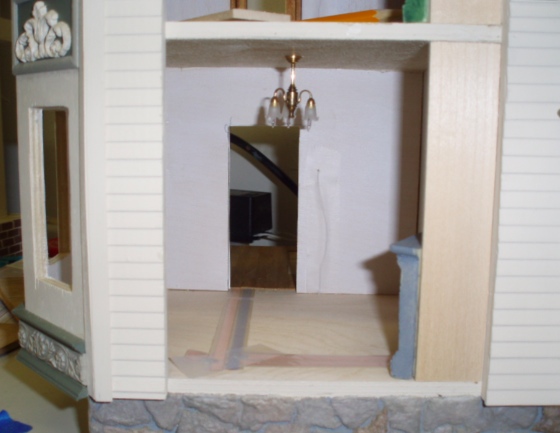
After the second mishap, I thought for a few days about how to proceed. Luckily I hadn’t damaged any of the paper on the adjoining wall (yet!), because I already attached a light to that wall and the wires are covered up with wallpaper and flooring on the other side. In other words, repapering the adjoining wall would be a no-go. At this point I felt like I only had one more try to get it right.

Instead of gluing the stiff paper to the wall this time, I cut my wallpaper and then glued it to the back of the paper instead. This way I was able to get the edges matched up perfectly. (For the bottom half, the fit of the stairs was too snug with stiff paper added, so I only did this on the top. Downstairs the offending wire is covered up by the staircase, anyway.)

It worked! There are a few glue smudges and wrinkles, but I think once the stairs will be in place they won’t be obvious. The side edge isn’t straight but with the hinged panel attached you won’t be able to see that.

Continue reading

Bay window rooms continued

Moving right along with the rowhouse living room and office. Here’s the French door downstairs. For the headers, I haven’t been too careful about making sure they’re consistently wide. This one’s almost too short… I glued the door in before I cut it, so just had to wing it. In retrospect I probably should have made it a tad wider. Oh well.

Here’s the second door in the office, which leads into the bedroom.

And here’s the open doorway in the living room, that leads into the kitchen. Originally this had an arched top but I filled it in with foamcore. This one’s a bit too wide, I should have cut it down but I didn’t realize until after I’d already glued the cove molding onto the top. So I left it. Hopefully I’m my own worst critic on this and no one else will notice. (Or if they do, they’ll be too polite to mention it.)

Started adding baseboards and chair rail. Also, in this picture you can see how I trimmed the inside of the kitchen doorway using thin basswood.

Continue reading

« Older posts Newer posts »

© 2025 The Den of Slack

Theme by Anders NorenUp ↑